Monday, April 23, 2012

Garden Gabbers @ Earth Day Chilliwack

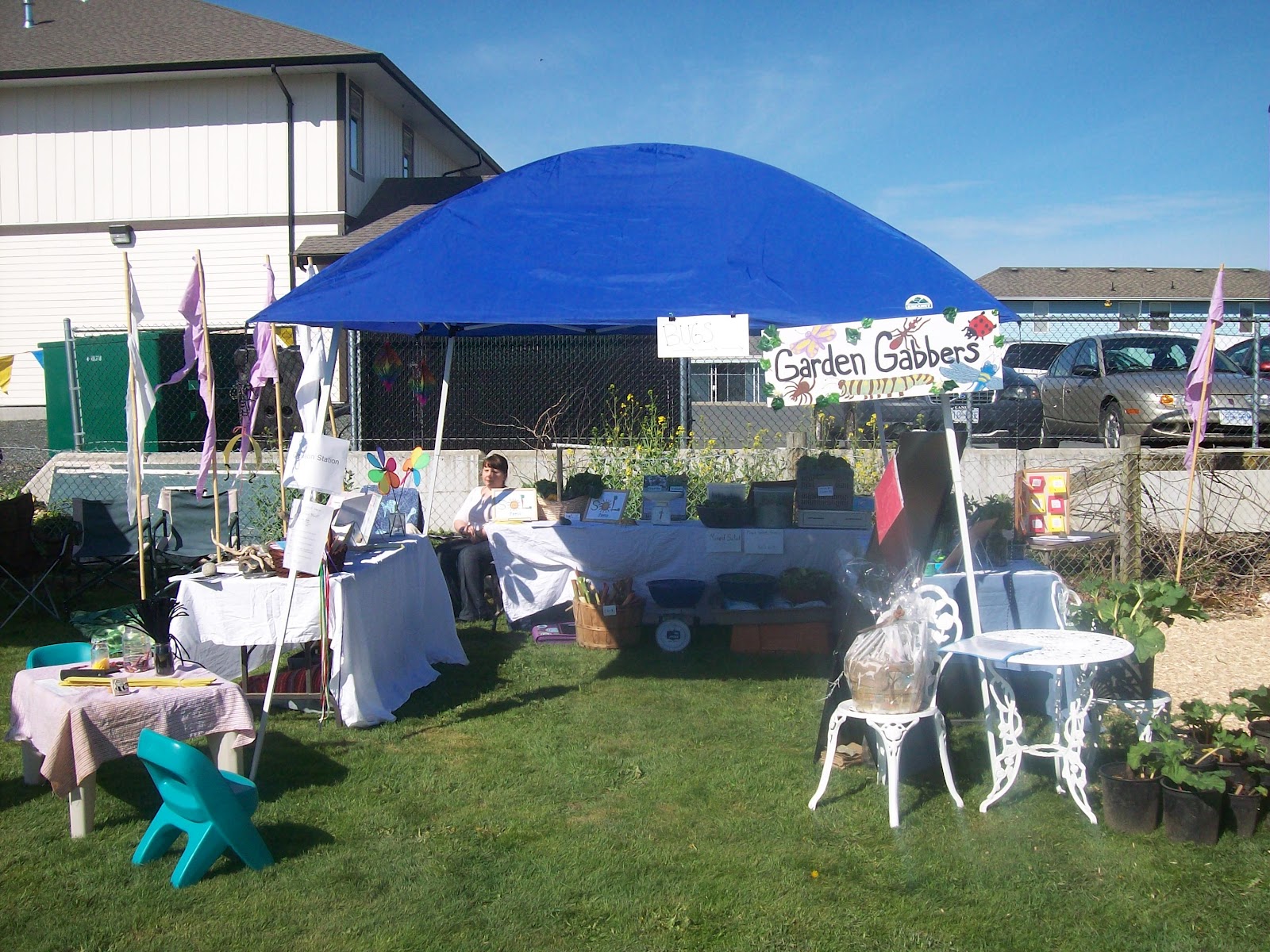
Garden Gabbers officially introduced itself to the community @ Earth Day Chilliwack this past weekend on April 21, 2012!


The "Creation Station" was a hit!


These girls model their 'bumble hat' creations!


Come on in and see what we got! So much packed under one tent!


There was bugs in jars for the kids to look at... "Edutainment" activities, games, scavenger hunt handouts, etc.


Plants for sale! (rhubarb, raspberries, lovage, mint, lemon balm and more). Still some available!

I brought the Fairy & Gnome picture board I painted... for fun! I loved seeing people stop for pictures...I bet I'll be seeing some across Facebook soon!


A closer look inside...


I can't believe our rhubarb plants in the front yard produced this much already! 


We ended up selling around 10 pounds of salad greens... a mixture of chard, pea shoots, lettuce, kohlarabi, cabbage, collards, anis, kale...  Jason got up at 3am to harvest, and everything was washed and made ready for the event before 7:30am!  And it hardly looks like we even touched the greens in our garden!  


 I loved selling my magnets! Still lots left for those interested in magnets with a 'local, food growing, farming, organic...' message.


 Jason joined Rachel to announce the "Community Gardens" ribbon cutting with the mayor. He remained busy coordinating the work party in the gardens during the day...


More pictures to come!


Tuesday, April 17, 2012

April Surprises

Mmmmm... back to salads and fresh greens everyday!


I can't believe the size of some of the wasabi leaves!


The garlic is coming up nicely!


We're excited for the soon-to-be-eaten pea greens and pods!


I love surprise produce! Several heads of lettuce are big and ready for plucking. These babies self-seeded themselves in our green house. 


 Rhubarb for sale! (You can pick them up at our booth @ Earth Day Chilliwack this weekend!)


And now for something completely different. (below) BEFORE


and AFTER!


And yes, there is always fun to be had even with the most tedious and/or strenuous garden chores! (P.S. This is our tenant's place).


After a day of pressure washing the fences, home and patio in the rain yesterday, I sure felt like a duck! And cold to bout!  But it gave me a reason to be OUTSIDE and connect with life and the natural world! 


The Joy of Arugula

I've discovered the joy of Arugula!  This wonderful green keeps giving and giving!

In January we started eating new green sprigs coming back from where the past season plant self-seeded the area around itself. The green is awesome in salads, sandwiches, and homemade pizza. It is also great in soups, stir fries, rice pilafs, pasta and more. However, we both agree that RAW is best to enjoy its full peppery flavor!


We can hardly keep up with what's growing in our garden. Most of our arugula plants are bursting into seed formation. We don't mind all that much, as we are happy to save seed for future 'seed exchange' endeavors AND ALSO, the seed is edible and can be used for sprouts.


With all this arugula in our garden , I wanted to know more about it. Here's what I learned: 


Arugula is a green and herb - it is a part of the mustard family, making it related to both the radish and watercress. This explains its hot peppery taste!  It is also known as "rocket" ("Perfect...as it's like a 'rocket' of flavor in your mouth!") and it is native to the Mediterranean region. Arugula is traced to the Roman period: they ate the leaves as vegetables, used the seeds to flavor oil and made aphrodisiac and medicinal compounds from the plant. Speaking of medicinal compounds, Arugula is a good source of vitamin A and vitamin C, folate, calcium and magnesium.


I also learned that the Garden Carpet Moth also has a palette for Arugula.


This moth is greyish-white with three irregular black blotches...  Adults can be seen any time between April to October. It is known to fly throughout the night, is attracted to light and is most likely one of the moths you will see in your lighted window! 


Not only will it feed on your arugula, it will feed on the rest of your mustard family (e.g. radishes) as well as your cultivated brassica family (e.g. broccoli). So now when you spot one of these moths looking pretty in your garden, or eerily perched on your window at night under the light... you know what 'cookie jar' its getting into in your garden. I wonder if dill will deter it, like I've heard it does with the cabbage moth?  Won't hurt to try! That is, to throw some dill seeds on the ground around these other garden goodies.


Now what to do with all this arugula... I came across some tantalizing ideas to start with:


Arugula Pesto
(Basically olive oil, garlic, salt and arugula). 


Arugula & Avocado & Apple salad!


And I am thinking about experimenting with an arugula & feta stuffed & grilled red pepper tonight for dinner!  

Thursday, April 5, 2012

More than a Garnish!


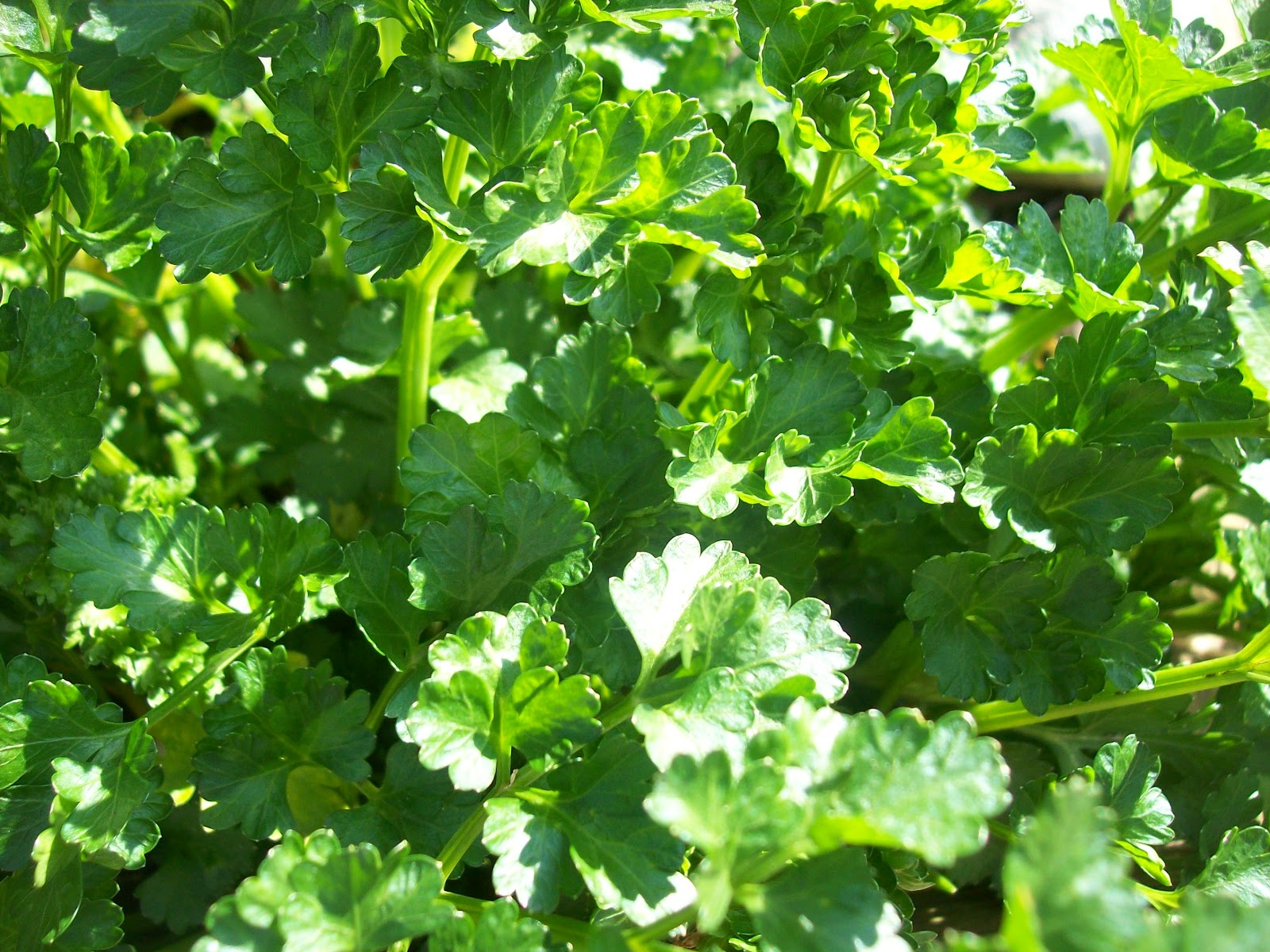
Picture: Taken today. My happy parsley patch. 

The other day I dropped in to visit my sister Susan - it happened to be just as she was preparing for dinner - meanwhile her boys, 3 & 5 years old, were getting peckish. On her window sill was a glass of water filled with parsley. She grabbed two moderate size bouquets (4-5 flower heads) and gave them to her boys. She explained how they just love them. In fact, they finished their bouquets and asked for more! Susan said, "I just can't keep up buying enough of it!" and gave a tip: "If you keep it in a glass a water, it will stay fresher for longer". I know she looks forward to picking it from her garden this year!


Wow! This made me think about how most of us overlook parsley. We tend to think of it just as a garnish. How many of us actually use it in our cooking, fresh or cooked? And how much do we use, a sprinkle or do we eat it like any other vegetable? And the ultimate question of the day is: Is parsley a herb, a vegetable or a spice? (I'll give you the answer at the bottom of this blog.)


I've made salads laced with parsley often at times when company has come over to dine and the typical response I have heard about it is, "Ew!" What is it about parsley that has conditioned us to think so? If people knew how good parsley is for them, might they reconsider?

Parsley is loaded with antioxidants and is at the top of the cancer-fighting foods list. It’s organic compound, myristicin, actually inhibits tumor formation. Luteolin (another organic compound) serves as an anti-inflammatory agent. Parsley is also loaded with vitamin C, vitamin A and vitamin K – which all strengthen the body’s immune system in different ways. It’s also a good source of folic acid and iron, and has 0 calories! It’s good for the heart and protects against arthritis and a whole bunch of other healthy benefits and goodness - that you can research more about.

What else is parsley good for?

When you chew it, it helps to freshen bad breathSo if you're out on a date, make sure to eat your ‘garnish’ after you finish your meal! You're date might think you have a daring palette, but you'll be one up on them :)

Parsley also is beneficial in the garden! 

It is widely used as a companion plant in gardens. Like many other members of the carrot family (umbellifers), it attracts predatory insects, including wasps and predatory flies to gardens, which then tend to protect plants nearby. These insects are especially useful for protecting tomato plants as the wasps that kill tomato hornworms also eat nectar from parsley. Also, the strong scent of parsley leaves mingle with the tomato scent and confuses the tomato moth. Good to know!  Hmmm.... Tomatoes and parsley also fit nicely together in a cold Quinoa or Couscous salad! So now you can have a one-stop-garden-harvest-plot!

How does it grow in the garden?

Parsley is a biennial plant that will return to the garden year after year once it’s established. My parsley has been coming up since early January. Each snowfall and frost period we've experienced since has stunted it a little, but it's back with a vengeance and I'm enjoying it regularly now!

What types of parsley can you grow?

The two most popular types of parsley are curly parsley (top below) and Italian flat leaf parsley (bottom below). The Italian variety has a more fragrant and less bitter taste than the curly variety. There is also another type of parsley known as turnip-rooted (or Hamburg) that is cultivated for its roots, which resemble salsify and burdock. (I've never tried growing the latter - if you do or know someone that does, drop me a line). 


If you haven't already planted parsley yet - get it in the ground as soon as possible. It takes off better when the weather is cooler and damp like it is now... It prefers well-drained soil and sunshine...(most plants do), but I find that its pretty hardy and able to withstand multiple conditions.

If you're parsley is growing for its second year, don't be surprised if you see it shoot up and go into flowers when the weather gets warm. Keep cutting it back to keep using it - and/or - let it go to seed and collect them for next year' seedy Saturday exchange!

Finally, the answer you have all been waiting for: Parsley is all three: a herb, a spice and a vegetable!


The Bears are Coming out of Hibernation!

I noticed a "fuzzy wuzzy" crawling on the gravel of my driveway the other week. That's what I called them growing up, as they seemed like the teddy bear of caterpillar family, 'cute and cuddly'.  Cute maybe, but cuddly not so much: they poop in your hand when you pick them up; they curl up and play dead and; their fuzz is rather bristly. Still, who can resist picking one up to play with and 'awe' at? I wish I had my camera with me at the time. Instead, I googled this creature to learn about it and 'why am I seeing it in my garden already?'


 It's known as the Banded Woolly Bear.  More specifically, "Pyrrharctia isabellawhich includes both the caterpillars identity and the moth it will become, the Isabella Tiger Moth (yellow to orange with a robust, furry thorax and small head; wings with sparse black spotting).

 
I saw a Woolly Bear last week because it just came out of hibernation! These caterpillars are one of select creatures that can freeze over winter, and come back to life when the environment thaws. Their body temperature can go down to -8! Their bodies create some sort of anti-freeze substance to keep them alive winter long, even though their hearts literally stop. Hmmm...so they've seemed to master the chronogenic freezing mystery!


Apparently there is an old wives tale that has to do with the width of their strips to predict the severity of winter: the more black strips the more severe winter. And the position of the bands indicate which parts of winter will be the coldest: if the head is dark, the winter starts out severe and; if the tail is dark, the end will be cold. Fun to think about and to test the theory next year. However, the Woolly Bear caterpillar’s coloring is actually based on the life cycle of the creature: how long it has been feeding, and its age. The bigger it grows, the narrower the red-orange band in its middle.

Once the Banded Woolly Bear comes out from its winter thaw, you'll only see it out and about for a few days to feed & to find a mate. Don't worry they won't necessarily snack on your garden goodies. They are generalist eaters that like things like: birch, elm, maples, asters, sunflowers, grass, dandelions, and yes, garden goodies like cabbage & spinach. Then after these few days, they will spin a silk cocoon (probably on the plant/tree/bush they are feeding from), which an adult moth will emerge from in about one month. There will be 2-3 generations of these caterpillars between the spring to fall, the last generation will be the bears that hibernate over the winter.

I can't wait to see more of these cute little guys!

For those interested in an interactive learning activity with these cute creatures - I came across a site that gives directions for capturing and watching these creatures metamorphosis from caterpillar to night butterfly (moth). How cool is that! 


Friday, March 30, 2012

Magnets & Earth Day Chilliwack!


Garden Gabbers will be at Earth Day Chilliwack!  I'll be selling my 'food growing, farming, gardening, local, seed saving, garden geeky' magnets!

Where: 45195 Wells Road at the Mathieson Center, Chilliwack BC
When: April 21, 2012 10am – 4pm


This is Why we Tie Em Up!


One of these raspberry rows is not like the other, can you guess which side is better for the growing season? (Did you have a tune go through your head when you read that question?)


So I pulled out the old canes and tied up the raspberries on one side. Now to do the other! The old canes are going to be put aside in a pile for the bees! (Read a couple posts below, and I'll tell you why). 

Blessed with the Beauty of the Small

Look what creatures are popping up all over my garden again this year... Grove Snails!


Grove snails are a common garden snail, also known as Cepaea nemoralis, introduced to North America from Europe (once upon a time). Why or when is unclear to me.  However, this makes them an invasive species - and this is only a problem if they are threatening native snail species. I wonder if they already have though because all I ever see snail-wise in my garden ARE Grove Snails! 


So the question of the day is: Are Grove Snails good or bad for the garden? 


They are good in that they are a sign that your garden environment is a healthy one as snails, slugs and frogs/toads are the first to disappear in the presence of chemicals and toxins. Bad in the sense they eat your plants!


I've read that they mainly like to feed on decaying matter and fungi; but I've also read that they will devour your foliage (be it produce or bedding plants). Yet, I typically find snails on the trees (bark), raspberry canes, and wooden items - not leaves. Maybe they are on-route? Maybe they know I am coming, and move away from the 'merchandise' (plant leaves, produce) to fool me? 


Last year we generally picked them off what they were stuck to and fed them to the chickens! They loved that! But this year we don't have the chickens and we're not planning to get them this year. So I am wondering what to do with the snails this year - as I don't like killing things. 


An organic suggestion given is to set out beer traps for them: they go in and don't come out. But I don't like the idea of plastic beer traps all over my garden. And it's still killing them:(


Some interesting facts about Grove Snails:


They are hermaphrodites and must mate with another snail to produce a fertile eggs. Mating is typically in late spring through early summer.  It takes a snail a year to mature, and three years to develop from an egg to a breeding adult! (Good to know they don't breed like bunnies!) And they can live up to 8 years! Wow...I can't believe some snails in the garden have lived on this property longer than I! That kind of gives things a new perspective!


In the winter, snails hibernate. They come out during warm spells. (That's why I find them in the dirt).  (Wonder if they eat more of your garden goodies in the fall so they can pack on the pounds for a long winter sleep? :)


Finally, the Grove Snail is actually an edible snail! So for those of you who like escargot - here's a 0-mile diet delicatessen for you!  Maybe this is what Jason and I should try this year? Perhaps I can get around the 'killing' aspect if I think of it "for a higher cause?" Higher up the food chain, more like it! I'm not entirely convinced about eating them just yet. But it sparks my curiosity. 


What about a snail aquarium? I've come across several people online who put Grove Snails in their aquariums and keep them as pets. Um, not really my thing.  Then again, they could be a food source for other pets like hedgehogs, turtles, ???


Some things to think about.


Wednesday, March 21, 2012

A Good Day for Gardening

A beautiful day to be in the garden!  Finally, a sunny break after all the crazy weather (snow, sleet, down pours) we've been having here!  It's also spring break and we have our friend Grant over for a couple of days to lend a hand. And "Oh Boy" the boys have been busy!


We laid down newspaper before spreading the mulch to help kill the weeds below. 


Looking good!


8 more raised beds (small squares) were added to the garden today.  Each bed works out to be around $16 to build (boards, soil, screws). (Load of soil = $45; all the boards (cedar 1 inch X 6 inches, 4ft long) = $70).  Jason will come build these beds for you in your garden! He'll bring the dirt and do the labor for $30 a bed. I'll post more about this soon.
* * *
Today, I transplanted lemon balm and chamomile into two of the raised beds, and cut wire to cover the dirt from the many cats that like to visit and poop in them!  I also dug up some rhubarb plants and potted them, ready for sale.
* * *
Grant did an amazing job unloading the dirt and bark mulch to go around the beds. How many wheel barrow loads did he do? He's going to have some sore muscles tomorrow!


Next, Jason finally got around to putting the door on the greenhouse! Yeah...no more ducking under and lifting heavy wet plastic!  (Just the other side to go for circulation before the weather warms).


And look, my hardy greens are sprouting. So are the knight and sugar peas I planted a couple weeks ago!


The irises and snow drops are in full bloom. The daffodils are about to bud.  My mother told me the other day that you are NOT to put other flowers in the same vase as daffodils, because their slimness you can feel when you cut them is actually poisonous to other flowers. She also said it makes no sense that stores sell tulips and daffodils in the same pots because the daffodils will even kill the tulips.  Who knew!?  
***
My favorite moment of the day was watching the bees (honeybees and mason bees) go into the irises, and come out all covered with pollen. Very cool! 
***
After being outdoors for most of the day, a BBQ was the way to end the fun!  BBQ steak & pork chops, with a Greek and faux-spinach salad (actually made with pea shoots and leaves) on the side, and a squash casserole.  Yum, yum!
***
Tomorrow we got more beds to make and another trailer full of dirt to fill them. I'm going to get started on tying the raspberry canes up and transplant the strawberry plants into a raised bed in the next week. Currently the strawberries are where there is a lot of buttercup growing and that's no good considering their leaves look very similar - and they are NOT edible (poisonous)!   Next, I don't want to pull out the old raspberry canes (when tying up the canes tomorrow), until I know the weather is going to stay warm enough for the bees. Old raspberry canes make great homes for wild bees and if you remove them too soon, you might be destroying bee homes :(    If you are someone who likes to remove your old canes at the end of the growing season... next year, I suggest tying them into bundles and placing them somewhere for the bees to move in over the winter. Finally, if this weather stays nice, it's also time to start my bee-happy flowers in the wild space. 


Happy gardening everyone!

Monday, February 13, 2012

Let's Spring into the Growing Season!

Jason and I are super excited for this year's growing season! Already Spring is showing its bright shiny face all around our garden. Our herbs& teas are awakening from their winter sleep, and already it's time to start planting!


Garden Goodies beginning to appear. Wasabi & Chives.


We have much to do this year to get it ready for our GARDEN GABBERS endeavor!   The outside of the house needs painting to start!  There is also more raised beds to be built and filled with dirt, so we can increase our food growing capacity.  We filled many of our raised beds with garlic this year, so we need to replace those occupied beds with new ones. We managed to get two new beds done this week, and already they have been filled with seeds.


It's the perfect time to start your Asian greens and any other hardy green like Kale and Chard. One new bed is stuffed full of all this goodness, and the second is full of Sugar Peas. In the week ahead I will be planting a couple more beds of Knight Peas and then to find a place for the Fava Beans.

This year Jason will be working on getting the door, and flaps finished on the greenhouse (before we start most of the planting inside: tomatoes, peppers, cukes). There's also the completion of the 'cold house' that needs to be tended to. Just the walls are up. They need a couple more layers of rock, and then to figure out the roof and the staircase (pathway) for an entrance.


This year we will be welcoming a BEE community! Our friends Rachel & Banning blessed us with a home-made bee hive as a wedding present. I am looking forward to learning more about beekeeping and have much to prepare to create a bee-happy-home-environment for them. I have found a spot that I am going to transform into a 'wild space' of sorts - where I will move over the herbs & teas that come back annually - and where I can add Borage, Bee balm, and Bergamot, and all sorts of wild flowers.


Next, we added a 'conversational piece' to our garden - our Christmas tree.  We decided to buy a potted tree this year - we'll have to see how "Chris" likes his new outdoor home, and if he's interested in joining us for next year's Christmas celebration.


So much to look forward to this year:


1) Garden Gabbers official launch will be in May!


2) Jason, Rachel and Dayna are spearheading a new CSA (Community Shared Agrigulture) garden this year they are naming S.O.L. Farms. This year is the test & learning run - they will only be selling 15 shares for fresh produce this year. Already there are 5 committed. If you want in, better let us know very quick.  Shares are 20$/week for a harvest box... the total weeks of which bring it to $400 for the growing season.  If they can not meet the value of $20/week for the harvest box, (due to poor crop yields) they will be offering refunds.


And oooo the garlic has started to sprout!  And speaking of sprouts... We just ordered a sprouting container from West Coast Seeds that's amazing!  Mmmm fresh sprouts every three days! Jason's school lunches are going to have extra pizazz now!