Tuesday, April 5, 2011

Rain, Rain Go Away!

Perhaps I spoke too soon about sunshine in my last blog :(  


I just can't believe this soggy weather we've been having for the last two weeks.  Our backyard is a mud rink and Jason's trailer loads of dirt into the backyard have destroyed the lawn (with the truck spinning out).  We can't really get much done in this weather!
   
Before the weather changed to wet and grey... here are some of the projects we were up to:


I am so excited.  Jason is building our second green house.  This one is more than twice the size of our makeshift greenhouse built a couple years back. The new greenhouse will be for growing all our tomatoes and peppers :)  All is needed now is a dry day to put the cover over the frame, build a door and some air/circulation flaps.  


Before it got wet and cold, I started transplanting our seedling trays into the greenhouse raised beds.


Here is a before and after shot of one of the many 'beautification' projects happening around our place, as we prepare our place for a string of summer guests this 2011 (as we are getting married in August).  You can also see (by the picture below) that I have been busy "crafting" for that event too :)   

Wednesday, March 23, 2011

March in the Garden

Well the sun is finally shining again and spring is definitely in the air! Let's hope those wet and cold days are now behind us.  As I predicted in my earlier post, I thought perhaps we would be in for another cold snap and snow - this was the case.  It didn't really slow us down.  The kale, radiccio, chives, wasabi persevered through it all and we can happily say we are enjoying it all in our salads.


Chives and Wasabi (above). Radiccio (below)


It's been a busy past month in our garden.  The raspberry stalks have been tied. The blueberry bushes have all been trimmed.  These two chores alone probably took over 25 hours. This is something that needs to be done each year around this time: raspberry plants grow new shoots every year, and if you don't train them where to go, they will grow out of control; you need to trim off the dead and diseased branches from the blueberries so the other parts have a better chance to thrive. 


 The seed trays that Jason started weeks are growing steadily and are ready to plant in the ground.   Before we get to that point, we have started making raised beds in the yard.  So the past couple weeks have been a work factory of staining the boards that will be used.  It will be interesting to see how food production will change with raised beds.   There are several reasons why we decided to work on this project this year.  1)  It takes away the need to rot-a-till the soil each year before planting (which is controversial in the first place - while it may help break up the soil for planting, it depreciates the nutrients in the soil (they become exposed and vulnerable to rain, wind, etc.).  2) Raised beds create a more suitable growing environment: more soil, less compact, more drainage for the plants, warmer soil conditions, etc. 3) It helps keep the garden tidy serving as a way to manage the weeds. This is something I will definitely love this year.  4) Having raised beds will help us make better use of the land by concentrating and intensifying our food growth.   Raised beds just seem to be the way to go this year - especially as we work to grow all our own food, and hopefully begin to grow produce to sell this year (to local restaurants, etc). One day. 


We have been busy hauling and shoveling dirt onto areas in the yard that are otherwise muddy and poor soil areas, even for the grass to grow.  Now is the time to do this, so we can get some grass seed down, and the path areas begin to fill-in in time for late spring and summer.   Last year we tried planting only clover in several areas that are designated as pathway areas, because it seemed to be the better choice environmentally: food for the bees, stays short and needs less mowing.  However, the clover completely disappeared when the winter came and is back to being brown and muddy.   So we decided to raise it up a level with soil that drains better (less mud) before seeding it with a grass that will last all year long.


Jason started making a patio area on the front lawn and some small raised beds.  We are hoping to turn the front yard into a little garden oasis as well...


There is always lots to do around here.   When it finally dries up a bit, we can get to the root cellar we didn't finish last year.  Too bad we didn't... the rain got the better of us... and now there is a wall of soil over top of our unfinished concrete wall (from surrounding collapsing walls...even the stairs are washed away).  It will be a chore just to clean up the cellar so we can continue working on it.  A summer job I predict.  


That pretty much sums it up for where we are at.  It's time we started our tomato seedlings and there is a whole of seedlings that need to get in the ground.   We'll keep you posted.  Check out 'spring' in the garden:)


Wednesday, February 16, 2011

Just Watching our Babies Grow

First Garden Salad of 2011


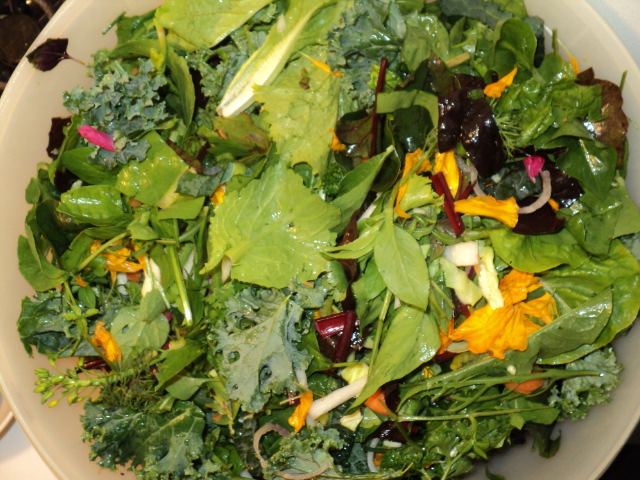
Happy Valentine's Day!  To celebrate, we gathered our first fruits of 2011 from the garden.  Here is our first 0 mile diet salad of the year with: Kale, Radiccio (leaves), sorrel, leeks, chives, wasabi (leaves), and fresh thyme.

Tuesday, February 8, 2011

Getting Back to the Garden

Plants are starting to grow outside and indoors :)  The wasabi plants (right above) look like they are off to a good start.   The chives are hoping to make an appearance soon as well (left in picture above).

Can you believe that Jason has already started the seedling trays!   Holy Crapole! The winter sleep was not long enough to recooperate from the dirt 24/7 (on the hands, on the clothing, tracked in the house), from the extra chores and hours added to each day and from the sore muscles and calluses.  But as the saying goes, the early bird catches the worm, and in this case, the early bird gets to start enjoying fresh garden veggies a heck of a lot sooner.  

I'd have to look back on my posts, but I think it was about this time of year that we started the seedlings and planting outside last year.  Still, I think its a bit to wet and ugly to be outside in the mud, but Jason thinks otherwise.  He has already rotatilled a row and planted the broad beans and fava beans and is eyeing a place to put the potatoes in next.  I'm expecting another cold snap for this year so I'm not yet convinced that everything planted (outside) at this point is going to survive.  But what do I know...you can't predict the weather, and you sure can't predict mother nature :)    

So far, Jason has started seedling trays for:  basil, thyme, lavendar, leeks, onions, artichokes, lettuce and asian greens: midwater gai lan, green perl gai lan, jade spring yu choi sum, toi choi pac choi and ching chiang pac choi.   I didn't know there was so many varieties of choi!  One thing I do remember about these plants from last year, is that they are extremely susceptible to those nasty 'flea beetles' (tiny black bugs :(   So you want to take proper care - when you are ready to plant them in the ground, cover them with garden cloth.

All the seedlings are bathing under very bright lights.  One so bright that in fact my hair dryer on the same electrical wiring popped the fuse.  Guess I'll have to find another place to dry my hair until the seedling season is over.  I wonder what the neighbors are thinking with the bright light coming out from the basement and one from the garage....'grow-op'?  Well, they wouldn't be far off...but in our favor, a legal one:)

* * *

 I love to experiment. I am learning that food gardening is nearly a year round activity here on the West Coast.  I've read that onions and leeks are day sensitive plants. Growing leaves from winter solstice to summer solstice, and then growing the bulb of a cooking onion from summer solstice to winter solstice. For every leaf, one layer of flesh in the bulb. Therefore the longer the growing season before June 21st, the more leaves, and then the larger the cooking onion. I planted my onion seed and leek seed on Jan 26th in trays with plain potting soil, and they sprouted about 5 days later. There is not enough sun for a month or two, so grow lights it is. Downstairs (warm) I use banks of CFL bulbs in old washroom fixtures (4 x 20Watt bulbs per fixture, 4 or 6 fixtures) plugged into a power bar with a built in timer for half of it's plugs. I also started some Chinese greens that I purchased from West Coast Seeds. About week later they too sprouted. After about another week I moved them out to the garage where I have my new 1000W metal halide bulb (more efficient than fluorescent bulbs when you get up to that much power usage). The garage is cooler and helps keep the little plants from growing too quickly and getting tall, thin and weak. While I too think it's still too early, I transplanted 3 little sprouts into the greenhouse today, beside the Swiss chard that has been starting to sprout for about 2 weeks now. I was planning on experimenting with a couple of each variety but the soil just felt too cold, compared to the seedling's soil from the comparably warm garage - that light keeps the garage about 2 to 3 degrees warmer than the outdoors. 

I want a soil heating cable. That would definitely help expand the growing season a few more weeks.  I love to try things that my training (school, books, internet research) and my common sense (soil too cold to the touch, no one else plants this early) tell me not too. This is because I want to verify that I'm right, you're right, and that surprises occasionally happen and everyone gets to learn.

Monday, February 7, 2011

The Garden Sleeps


   The garden takes its long winter's nap.  Well, not the Kale - it perseveres right through :)    (December snowfall). 

Friday, December 10, 2010

Gardening in December

After our first snow fall disolved and the weather warmed a little, I was out in my garden digging up the rest of our carrots, beets and rutabegs. A perfect combination for bortsch and stews...comfort food in this cold, dark, wet time of year.   


The last remaining delight in our garden is the Kale - the sole survivor of the winter cold.

Trimmed back the annual herbs, so they are ready for new growth in the spring.  I was surprised to see the new growth already starting... the mint, oregano, and lemon balm...  

I think the earth needs a longer sleep!

Sunday, November 14, 2010

A Garden Salad to Gab About

Get it while it's still growing!!!

Here's our amazing salad we made today, packed full with 30 different ingredients all from our backyard!!!  I picked each ingredient fresh today (except the onions which were picked a couple weeks back).

1. Lettuce (grand rapids
2. Spinach
3. Bright lights Chard
4. Ruby red Chard 
5. Curly Kale
6. Winter Bore Kale
7. Sorrel
8. Arugula
9. Collards
10. Buk Choy
11. Carrots
12. Red Onions
13. White onions
14. Chives
15. Dill
16. Cilantro
17. Mint leaves
18. Thyme
19. Lemon Balm
20. Kohlorabi
21. Beet greens
22. Gypsy pepper
23. Dandelion greens
24. Chickweed
25. Marigold petals
26. Rose petals
27. Pea leaves and some pods
28. Parsley
29. Chicory greens
30. Celery tops

That's was fun!  Such a treat to enjoy most of these greens a little while longer, before the frost comes:)


Monday, October 18, 2010

Fall in the Garden

It's been a couple weeks since I posted and I thought I should gabble a bit about our garden:


All the tomatillos have been harvested and processed into 'green salsa'. We like to call it "That be damn hot salsa, quick get me the fire department!" It's loaded with all sorts of chillis :) Unfortunately, this year we forgot to plant our 'damn hot' chillis and so we had to make several trips to the market to buy some.

The rose hips have been plucked from their thorny hosts. Scraping out the seeds and hairs on the inside proved to be more difficult than expected. The finished product doesn't seem worth the effort. However, I will leave it up to their taste appeal to make my final judgement call. For now, they are in the freezer until I find the time and decide on a perfect recipe for the taste test.


I harvested a armload of rhubarb from our front garden. It's growing in a front flower bed, filling in space, and looking pretty - so I didn't want to hack too much of it away. I chopped it all up and added some to an apple rhubbard crips (using the apples harvested in our yard). The rest I put in a zip lock bag for the freezer for another day (maybe a jelly, or a pie, or a syrup....possibily?)


The winter wheat has been planted.  The squash have all been harvested.


The garlic cloves have all been planted in time before the winter frost. Approximately 1300 garlic cloves (of 15 different types) have been planted in time before the frost (thanks to Jason's amazing garden superpowers:) We planted our garlic crop at my father's place this year - his soil is well cultivated and deep. He even rotatilled the ground to make raised beds. We expect the garlic to fair much better this year under these conditions. Next, we will plant our 'bubil' seed garlic at our place - because it grows much more slowly/smaller than garlic started from cloves. We want to keep it under close observation as we have never started garlic from bubil seed before.


It's now 'soup season'.   It's this time of year when we make our delicious home-made soups from scratch and freeze our leftovers for cold winter days when the garden is no longer in bloom.   Bortsh is a popular one -full of garden fresh potatoes, onions, carrots and beets.   Curry zuchinni, and spicy squash soups are also tasty delights.  I tried a cream of jersalem artichoke soup the other day and the next soup on the menu is 'cucumber'something, as we have a bunch to use up.

* * *
We began to dig up our Jerusalem artichokes (otherwise known as 'sunchokes').  They're not really artichokes, they're a tuber.   They have the consistency of a potatoe, but the flavor of an artichoke.  We really enjoyed them cooked in butter, garlic and lemon.  The creamed soup was also really delicious.  Now to come up with different recipes for this unique vegetable.  

A couple things about Jersulem artichokes that we really like. 1) They make beautiful greenery in the garden, growing about 10 feet in height.  2) They grow back every year (so make sure you put them in a place you would want them to be next year).   We pull up/out the plant to harvest the roots and then put the stalks (with a bit of root on them), back in the ground to grow again next year. 

* * *
We witnessed the first sign of frost in the mornings this past week. So we need to use up our leafy vegetables that are still growing... spinach, lettuce, chard.  The collards and the kale will keep a while yet.  The others can be put in the freezer for later use (e.g. frozen spinach is great on home-made pizza:)

That sums up our garden gabble for the week.   Now to carve up those giant pumpkins in time for Halloween:)

Monday, October 4, 2010

Slowing Down

It's now October and we have slowed down a great deal in the garden.  One, we have become busy with other priorities including work and school.  Two, we have had a great deal of wet weather.

All the tomatoes are now gleaned and processed.  A large number succumbed to blight. Several pounds remained green. And a fair share were and continues to be enjoyed in salads.  There is nothing like fresh, sweet garden tomatoes :)    All the green tomatoes and tomatoes showing the first signs of blight were made into salsa and tomatoe sauce.     A big batch of Chilli and (spagetti sauce) in lasagna was also prepared and put into the freezer.

Jason has rotatilled several areas of the garden. It's ready for the winter wheat.  The remaining garden items are the carrots, beets, chard, kale, collards, squash and giant pumpkins.  Everything else has been turned over into the soil.  This weekend, Jason also added another two layers to the root cellar this weekend, during the sunny break in weather we had.   We are crossing our fingers that we get another couple breaks of sunny weather so we can get the cellar done before the winter.

Left to do...

Pull out the summer bulbs (gladiolas, dalias) so they don't freeze over the winter and plant the spring bulbs (iris, daffodils) so they flower in the spring.    Also, its time to harvest the rose hips.  They have turned bright red and sweet.  Apparently they keep well in the freezer. If I don't have time to use them, that's where they will go and so we will find out how well they keep. 

The biggest jobs left to do before the winter are:  planting the garlic and trimming all the trees; and moving the odd tree around in the yard.   

And that's about it.  We have slowed down, like the garden.  There is never enough 'thyme' to spend in the garden.   And so I leave you with advice by Ilan Shamir:

Take Thyme for yourself.

Cultivate lasting friendships.

Enjoy the fruits of your labor.

Plant seeds of kindness.

The grass is greener here.

Thursday, September 16, 2010

Dalia Delights

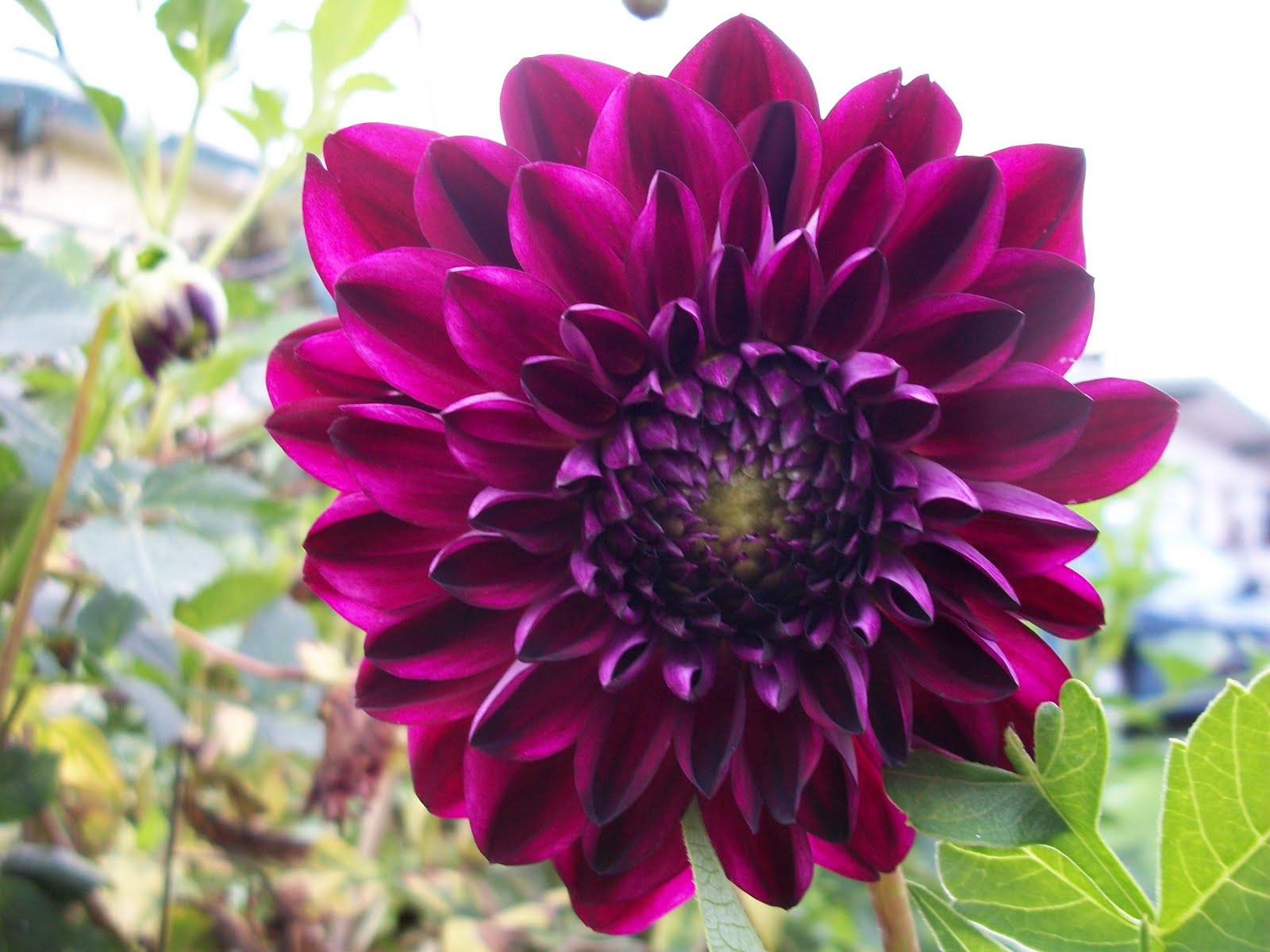
My beautiful dalias! 
(We dug out the tubers from my Dad's garden last year and planted them at our house)

Here are most of the colors we grew!   I trimmed back the dead flowers today hoping that they will give one more burst of color before the weather turns grim.  Note: Dalias have to be dug out before the frost, and stored in a dry/dark place over the winter (and can be planted as soon as the ground can be worked in the early spring). 

Other Garden Gab

Today I planted some winter veggies, brocolli and cauliflower.

A work in progress.  Work was started on the root cellar, but then the rain came.  Hopefully it clears up so we can finish this project THIS year.  We have a wheel barrow of potatoes to store inside among other items.  We both think a round hobbit door would be an awesome touch!

Stupid hornets.  We have a busy hornet family that lives in the crack between the back steps and the backdoor.  Using Rosemary for cooking is totally out of the question, as it marks the hornets' front door.  If you look really closely you can see a hornet guarding the crack.  We are waiting till they sleep (winter) and we will seal the crack.  Bye-bye biting nuisance! 

More Garden Goodies

The beets are popping out of the dirt. Think they want to be picked?


Giant pumpkins grew from last year's seeds thrown in the compost pile (as they usually will).  Pumpking carving fun is ahead.

We planted more lettuce to use at the end of the summer, there is also arugula growing (another salad leaf), rutabegas and turnips are to the left and just about ready...

The sunflower seeds have been harvested. Right now they are drying.  There is a bit of work ahead to soak them, salt them and roast them before eating them :)  Some seeds aren't worth the bother and we will use them for bird seed.


What do you do with Kohlorabi?  Salads and stirfries...  This is a new vegetable for both of us this year - we are still trying to find the perfect recipe.


Beans of all colors.  I harvested the dry and overripe beans before pulling the decaying plants out of the ground to compost.  The bean in side the pod are great to use to make soups or chilli.  We made a great batch of chilli with a bunch of beans harvested a couple weeks ago - with other garden veggies.  The only ingredient we used that wasn't local was 'chilli powder'...but its not really chilli without it :)

Hopping for Hops

The Hops are about ready!
The are crunchy when squished and they rebound back into their original shape once released.
Now for the tricky part, harvesting them. 
We will have to be extra careful as on the other side of the fence nearby there are two dogs.  Hops is super duper poisonous to dogs and will if eaten by them - it will kill them.

These hops will be dried and stored for tea and perhaps if we feel the itch, home-brewed beer :)   It's the hops in beer that help with producing milk for nursing mothers - so this tea might come in handy for some of you expectant and nursing mothers....just ask for a cup:)

For more information on harvesting Hops...this is an excellent clip on Utube http://www.youtube.com/watch?v=UVxuVzDz_L0


Fall in the Garden

It's fall in our garden.  The hot sunny weather has been replaced by rain and more rain.
While some items have bit the dust due to the change in weather, mainly tomatoes, other items are flourishing as you can see by the pictures I took today.  

Tomatillos
Squash

Cucumbers

Tomatoes (in the greenhouse only).

Collards (Cabbage family).

Kale

Wednesday, July 21, 2010

A Garden Update, July 2010


We spend much more time gardening than we do blogging.  Thought it was about time to give everyone a quick update on the garden and where we are at:

1. Jason estimates that we have picked our raspberry bushes every 2-3 days for about a month; and there is still one more good picking left, before the sun finally gets them.  We have about 20 pounds in the freezer awaiting transformation into something delicious.  We have use some raspberries so far to make raspberry beer (homemade brewed kit), raspberry juice and shakes, and of course it's always a welcome addition to a bowl of cereal and pancakes. 

2. We are enjoying blueberries and strawberries.  Both require picking every 2-3 days as well.  We have mostly been eating them off the plant, straight into our mouths...mmmmm.   Last night we pick about a llb of red currants....in addition to a pound I picked last week.  The jury is still out on what to do with these berries, so off to the freezer they go!

3.  The last two weeks were a 'pea party' paradise (minus all the work). Our garden contained 4 big rows of Knight shelling peas, from which we picked 36 lbs of peas (with shells), making 15 lbs of individual peas to freeze.   Time spent picking the peas, 6 hours; shelling, 8 hours; blanching and freezing, 1 hour.   The shelling part was the most time-consuming, until a pea sheller was borrowed (it came a little too late though - only about 10 lbs of shelled peas left to shell by the time it came).  The difference? The peas sheller (which is more like a pea thrasher) shelled these peas in 7 minutes (compared to the 3 hours it would of taken us two to do by hand).   Best way to shell peas?  Watching a movie and relaxing after a hard day in the garden. 

4.  We have been eating potatoes from our garden since June.   Jason figures we get about 3-4lbs of potatoes per plant - and we have about 120 plants in our garden (and another 150 plants in my Dad's garden because we ran out of room for them here).  Right now we are feasting on Red Poniacs - Jason and I dug up two five gallon buckets full of potatoes yesterday (~50lbs)...   We have been enjoying fresh potatoes as hashbrowns with our fresh urban chicken eggs pretty much every second morning, potatoes as french fries, and an item on our 'to do' list today is making shepherds pie and chicken pot pie to freeze (using up the potatoes and other yummy vegetables in our garden). 
  
5.  Other veggies that we are busy munching on: 

a. Kolhrabi -  a purple plant that tastes kinda like a turnip to me, but Jason thinks it tastes more like a diakon.  The leaves of this plant are edible as well, and they taste awesome in stirfrys or soups.  We eat the Kolhrabi raw in salads, or toss them into a stirfry as well.

b. beets - we have started pulling out the odd beet here and there.  They still need a bit more time growing, but there is the odd one that is needed on our plate from time to time.

c. carrots - 'mmmmm, what's up doc?'  Pulling the carrots straight from the soil to munch on reminds me of being a kid and doing the same.  There is nothing tastier than local-grown carrots  - store bought is just NOT the same!  

d. beans- I picked my first handful of beans yesterday. I steamed them for lunch and shared the 'first fruits' with my Jason.  Looks like I will be missing much of the beans when I am away in the summer - Jason will have to enjoy them for me.

e. onions - We pull the odd one out from time to time, but most of them need more time to develop into a cooking onion.

f. greens (lettuce, spinach, kale, swiss chard, collards, cilantro, dill, basil,) are all ready for the munching (and most have been so for months).

g. squashes - we are starting to see our squashes form. The sunshine that we finally got, has played a big role in their growth.  We have starburst 'bursting' forth and zuchinni, spagetti squash and acorn planted this year and a couple types we are not sure of yet (surprise seeds).  Somewhere in the garden is pumpkin plants, not sure how they are fairing yet, I think they got in the ground a bit too late.  Also, a couple egg plants which haven't seen to grow much either. 

h. Tomatoes - Our tomatoes plants are gigantic - and we are waiting for the green fruit to ripen. There is also tomatillos (green tomatoes) sprouting up in the garden - looks like we will have quite the harvest again this year.  And of course, Jason will be busy in the fall making his famous green salsa. 

There is not enough room to talk about all the goodies in our garden....or is it, enough space in my brain to remember all the items... what have I left out?   Jerusalem artichokes, horse radish, raddishes, califlower, broccoli, asparagus, artichokes, grapes, hops, (black and red) currants, gooseberries, gogi berries, logan berries, corn; Trees: pecan, walnut, halzenut, chestnut, cherry, apple, nectarine, plum, asian pear, apricot, pear, peach, fig, olive;   herbs gallore, edible flowers and I know I have forgotten a bunch more....
     

Garlic Gathering

The garlic is out of the ground.  Jason and I spent a good 8 hours digging, braiding and hanging the garlic this past Saturday. It probably took more time than that, but you lose all sense of time when you are out in the garden.  This year was a pretty bad year for garlic, and not just for us. The weather being so wet as it was, and the amount of rain we got through June, didn't leave much time for the garlic to dry out and much of it went to rot.  Well, it started out with a rust on the leaves back in June.  Jason attended to the rust by cutting off some of the rusted leaves, as it spreads by spores in the air, he then put a baking soda mixture on them, to protect the flesh of the leaves.  Even though we had rust on the leaves, most of these garlic bulbs turned out alright.  We did have a bunch with white rot (the most common), and a handful of black rot, and two bulbs with green rot...bizarre.   And the rest, is hanging to dry to plant again in the fall - and hopefully, next year, we will do better.   We started off planting 500 cloves this year, and have around 250 bulbs to plant again this year (each differing in the amount of cloves....anywhere from 4-8 cloves on each bulb).  We have about 100 bulbs that are either 'unknown' (because we forgot to label them along the way) or 'semi-moldy' (but okay to salvage) that we plan to use for eating.  Here is what we documented:

Unknown, 94 good bulbs, (which we will eat)
Georgian Fire, 15 good bulbs, 0 bad
Piteretti, 29 good, 2 bad
Russian Red, 90 good, 9 okay (experiment to see if they turn out okay after drying), 37 bad
Portugeuse, 6 good, 2 okay, 2 bad
Music, 19 good, 2 bad
Lenningrad, 7 good, 12 bad
Elephant Garlic, 11 good
Portuguese, 11 good, 7 okay
N. Quebec, 1 good (sniff, sniff), 1 okay, 10 bad
German Hot, 17 good, 23 bad

Notes to self for planting next year's garlic:
* always plant your garlic in a different spot from the year prior (up to five years)
* raise the beds (we will try making them higher this year) 10 inches is ideal (we will do our best)
* nitrogen hungry bastards - prepare the beds with manure

I think we would have done a bit better with our garlic this year if our beds were raised... the soil on our property drains rather poorly...and with so much rain, the molds could not be helped...would be different if there was better drainage.

* * *

At the end of the day, I made a tasting tray of the different types of garlic, and Jason and I spent a bit of time tasting them and making comments (a little warmed brie cheese and corn chips to help them go down too:). Here is what we thought about the garlic we tried:

In order of favorite to least favorite (least favorite still being super delicious):

Piteretti - yellow in color - very creamy...mmmmmm
Portugeuse - yellow in collor, creamy, light
Music - white in color, sweeter than the rest, nutty in flavor a bit
Russian Red - white in color, very earthy taste
Leningrad - yellow in color, fruity taste like apples